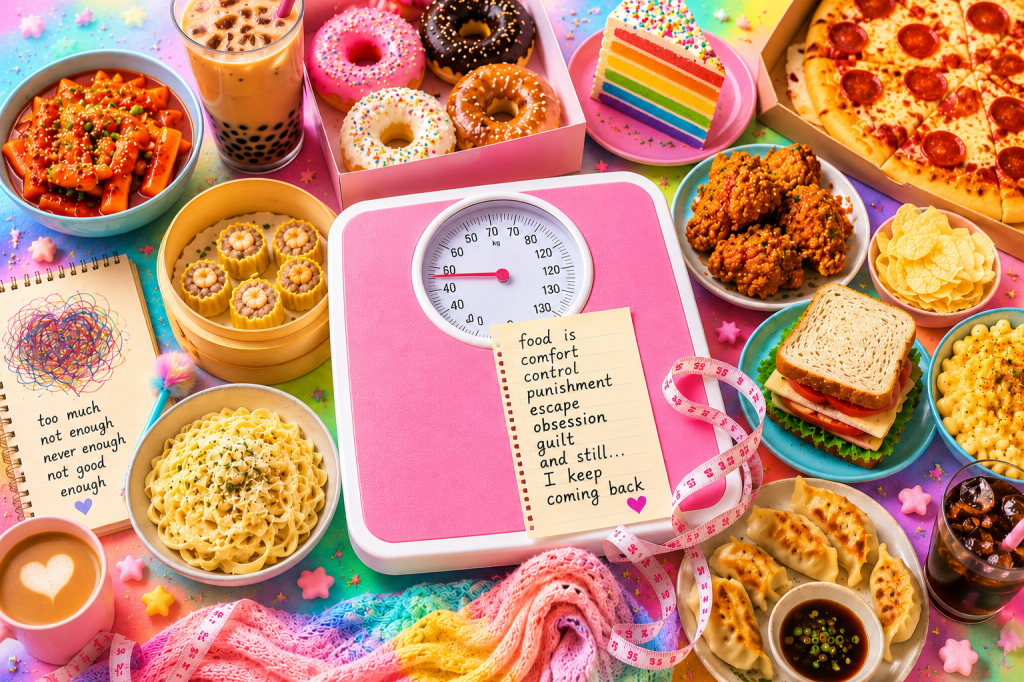
I’ve had a complicated relationship with food for as long as I can remember, but it really began when I moved away from home in high school.
I was alone for the first time. I was homesick, stressed, and overwhelmed. And food became the easiest comfort.
I ate everything. KFC almost daily. Hawker center food. Late-night instant noodles with canned tuna. Snacks from convenience stores. Milk tea runs. Vending machine food between classes. I had complete freedom, and I used it to eat whenever I felt anything ~ bored, sad, lonely, even happy.
Food wasn’t just food anymore. It was comfort. It was distraction. It was something to look forward to.
And within a few months, I gained weight quickly.
Then something shifted.
When I later went through a heartbreak, I lost weight without trying. And people noticed. They complimented me. They praised me.
That was the moment everything changed.
Being skinny started to feel like control. Like success. Like proof that I had my life together.
So I leaned into it.
I started restricting. Counting calories. Skipping meals. Pushing myself further and further. And the more weight I lost, the more in control I felt, not just of my body, but of my life.
But control has a way of turning on you.
What started as restriction turned into a cycle: binge, guilt, starvation, repeat.
I would eat until I felt physically sick, ordering enough food for multiple people, eating late into the night, chasing some kind of emotional relief. And then the next day, I would punish myself. Starve. Over-exercise. Try to erase what I had done.
It didn’t matter that I was never “overweight.” It didn’t matter that most of my life, I was considered skinny.
It was never about the weight.
It was about control.
Whenever my life felt unstable ~ emotionally, mentally, relationally, I turned to food. Or I turned away from it. Either way, it gave me something to hold onto.
Food was predictable. Safe. Always there.
People aren’t always like that.
Food doesn’t judge you. It doesn’t leave. It doesn’t misunderstand you or respond the wrong way. It just exists, quietly, ready to comfort you whenever you need it.
And that’s what made it so hard to let go of.
Over the years, this pattern followed me everywhere ~ from Singapore to the U.S., to Australia, and back home again. Different countries, different cuisines, different environments, but the same cycle.
Binge. Restrict. Obsess. Repeat.
My weight fluctuated constantly. My thoughts were consumed by food, numbers, and control. I built entire routines, habits, even identities around it.
And the strange part is, from the outside, everything looked fine.
I was still “the skinny one.” No one questioned it.
But internally, it was exhausting.
Even now, I can see the pattern clearly: whenever I feel anxious, rejected, or emotionally overwhelmed, I go back to controlling food. It’s my default coping mechanism.
Not because I’m hungry.
But because I’m trying to feel safe.
I used to think this was something I needed to “fix” completely. That one day, I would wake up and be free of it forever.
Now, I’m not so sure.
Maybe this is something I learn to manage, not eliminate.
Maybe healing isn’t about never struggling again, but about understanding why I do, and being a little kinder to myself when it happens.
I’m still learning.
Some days are better than others. Some days I don’t think about it at all. Other days, it’s louder.
But I’m here. I’m aware. And that already feels like progress.
If you’re reading this and you see yourself in any part of it ~ just now you’re not alone.
This isn’t as uncommon as it feels. It’s just not talked about openly enough.
And maybe we don’t need to have everything figured out right now.
Maybe it’s enough to take it one day at a time.
To start over, as many times as it takes.
Because we’re allowed to begin again.
Every single day.

 Mindful Minion
Leave a comment