For the past few months, I’ve been taking medication for my mental health. I still have emotional meltdowns. I still wake up anxious sometimes. There are moments when my emotions become bigger than my ability to express them, and I lose control a little. So I can’t honestly say, “The medication fixed me.” I don’t even know exactly how much it is helping. Sometimes I take it when I’m anxious and later feel a little better. Maybe the medication is helping. Maybe it’s partly psychological. Maybe it’s both. I don’t really know.
But I do know that taking it gives me something surprisingly valuable: a next step.
When I’m anxious, sometimes I suddenly realize, Oh. I’m late taking my medication. So I take it. I know it is not some magical pill that could possibly erase my anxiety five minutes later, but something inside me settles anyway. Because now I have done something. There is a process. I can wait and see what happens.
Anxiety has a strange way of creating another layer of anxiety. You are not only anxious about what is happening. Sometimes you become anxious about the fact that you are anxious. You start worrying about why you cannot stop worrying. Having a next step interrupts that cycle.
And perhaps that is one of the reasons I am glad I take medication, even if I still don’t know exactly how much it is doing. It gives me hope. It makes me feel like I am participating in my own recovery instead of simply waiting for myself to magically become a different person.
I could tell myself that I should be strong enough to figure everything out on my own. I could decide that needing medication means I am weak. But honestly, why?
It is 2026. Human beings have spent thousands of years inventing tools to make life easier. We created electricity, medicine, transportation, the internet, washing machines, air conditioning, and approximately seventeen billion ways to make coffee. And then I am supposed to look at a tool that might help me and say, No thanks. I prefer suffering manually.
Why?
If something exists to help me, and I have access to it, I see no virtue in refusing it just to prove that I can survive without it.
And somehow, that idea has led me to something much bigger.
Karma.
I have believed in karma for a long time, but recently, I have started paying attention to it differently. Not just as a spiritual idea, but as something I can observe in my own life.
Over the past month or so, I have experienced a few things that felt almost absurdly fortunate. People went out of their way to help me in ways I genuinely did not expect, and when I looked back, I could connect those moments to times when I had gone out of my way to help someone without expecting anything in return. Once, I could call it coincidence. Twice, maybe. But when I saw the pattern repeat, I started paying attention.
Eventually I thought, Oh my gosh. Karma is fucking real.
Maybe I am wrong. Maybe some of it is coincidence. But I have experienced enough of it personally that I no longer feel comfortable pretending the connection means nothing.
And this has changed the way I think about difficult experiences, too.
If karma is real, then what happens when something unpleasant happens to me? Someone hurts me. Someone doesn’t treat me the way I wish they would. Something doesn’t go my way. My first reaction might be anger, resentment, disappointment, or sadness. That part may be completely involuntary. But what I do next is another matter.
This is where I think we often create another layer of suffering. Something hurts us, and then we complain about it. We blame. We criticize. We lash out. We replay it in our heads. We become resentful. Suddenly, we are no longer just experiencing the original problem. We are creating something new on top of it.
That reminds me of anxiety. When I am anxious, sometimes the second layer is worse than the first. Why am I anxious? Why can’t I stop? What’s wrong with me? I become anxious about being anxious.
In the same way, I sometimes think we become resentful about the things that hurt us, and that resentment becomes another seed.
If I believe that something unpleasant may be the result of a cause I planted before, then why would I respond by planting another unpleasant cause?
It is like paying off one debt and immediately taking out another loan.
Maybe I am finally experiencing the result of something old, and instead of letting it end there, I create another reason for the cycle to continue.
So if someone is unkind to me, perhaps I don’t need to become unkind in return. If someone doesn’t give me the love or attention I want, perhaps I don’t need to punish them for it. If life gives me something I don’t like, perhaps I can simply say, Okay. I don’t like this. But maybe I don’t understand the whole story.
And then I can choose what I plant next.
That doesn’t mean I have to tolerate everything. It doesn’t mean I can’t protect myself, set boundaries, or walk away. It simply means I don’t have to add hatred to pain.
And this is where karma becomes strangely empowering to me. Because I don’t believe I control everything that happens to me. But I do believe I have control over what I do with what happens to me.
Maybe I wasn’t born with the same intelligence as someone else. Okay. Then I can work harder. I can study more. I can practice. I can become more disciplined. Maybe I will never become the smartest person in the room, but I can still improve the result I get from the circumstances I was given.
If intelligence is one factor, effort is another. That effort is also a seed.
The same applies to almost everything. If I am naturally reactive, I can cultivate patience. If I am fearful, I can cultivate courage. If I am anxious, I can learn how to care for myself. If I don’t have the life I wish I had, I can still decide what I am going to do with the life I have.
That is why I have stopped thinking of my limitations as a complete sentence. They are simply part of the conditions I was given. What I do next is still mine.
And maybe that is what I have been learning from both medication and karma.
Medication reminds me that I don’t have to refuse a tool just because I wish I didn’t need it. Karma reminds me that I don’t have to accept every circumstance as completely outside my control.
There are always things I can do. I can take the medication. I can go to therapy. I can pray. I can apologize. I can study. I can help someone. I can walk away. I can keep quiet. I can choose not to react.
They may look like completely different actions, but to me, they are all versions of the same thing:
I am choosing what to plant.
And perhaps that is why I have become much more careful with my thoughts, my words, and my actions. Not because I expect the universe to reward me immediately, and not because I want to manipulate karma into giving me the life I want, but because I have started to believe that nothing is really wasted.
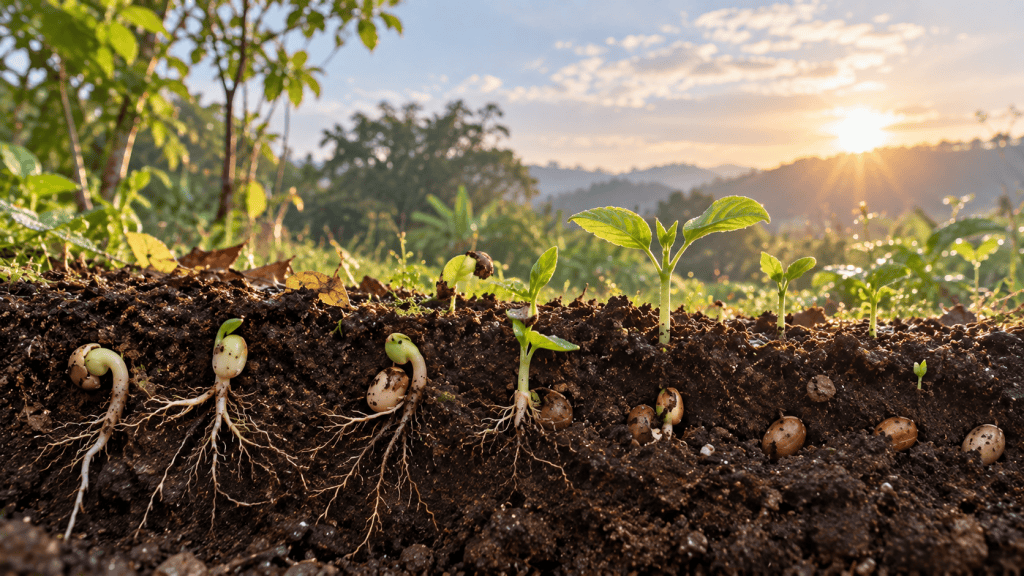
A kind thought is a seed. A kind word is a seed. An act of generosity is a seed. Patience is a seed.
Resentment is a seed, too.
So is cruelty.
So is bitterness.
And I get to choose which ones I keep putting into the ground.
I don’t know when any of them will grow. Maybe tomorrow. Maybe ten years from now. Maybe in a form I won’t recognize. But I have started to believe that they will grow somehow, somewhere, in some way.
And that gives me a strange sense of peace.
Because I don’t have to control the whole garden.
I just have to pay attention to what I am planting.
I am more than thirty years into this life now, and I think I am finally beginning to understand something:
I have more control than I thought.
Not over everything.
But over the seeds.
And maybe that is enough.
Because if karma is real, then every good thing I do matters. Every effort matters. Every act of kindness matters. Every time I choose patience over resentment, it matters, even when I cannot see the result yet.
The seed does not become meaningless just because I cannot see the tree.
It may simply be growing somewhere beneath the surface.
And maybe that is the part I am learning to trust.
Keep planting.


Leave a Reply