Have you ever realized that you said the wrong thing, handled a situation poorly, or made a mistake, and immediately started freaking out?
Oh my God, why did I do that? Why didn’t I say this instead? Did I ruin everything? How do I fix it?
And suddenly, you’re overthinking, overexplaining, over-apologizing, and trying to correct something that happened five minutes ago as if your entire future depends on it.
Sometimes, you even overcorrect the correction.
I’ve been there. And I’ve come to realize something that helps me tremendously:
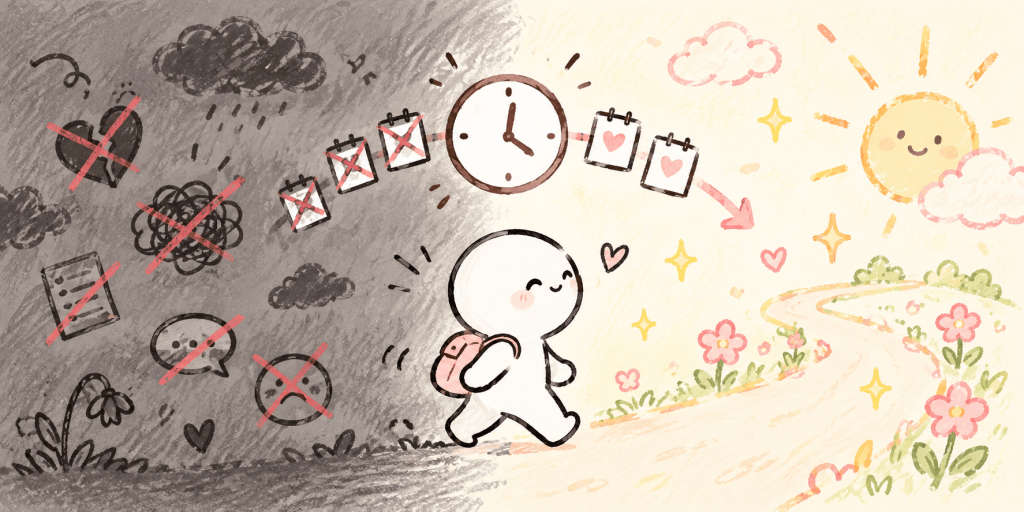
Time is on our side. We don’t have to fix everything right now.
The Past Is Not as Powerful as We Think
Whatever has already happened, happened. I’m not dismissing trauma, serious wrongdoing, or experiences that genuinely hurt us. Some things require accountability, healing, and meaningful repair.
But for so many ordinary mistakes, awkward interactions, embarrassing moments, and imperfect first impressions, we give the past far more power than it deserves.
You said something awkward at a party. You had a difficult conversation with a colleague. You handled a friendship poorly. You made a bad impression on someone you’ll probably never see again.
And now you’re treating it like a permanent stain on your existence.
But life keeps moving.
Five minutes later, something else happens. Tomorrow, people have other things to think about. Next month, you’ll have new experiences, new conversations, and new opportunities to show up differently.
The moment has passed. Your life hasn’t.
Sometimes, the kindest thing you can do for yourself is stop treating a single moment as though it defines your entire story.
You Can Always Course-Correct
One of the most wonderful things about being alive is that we can change direction.
You can learn to communicate better. You can become more patient, more confident, more compassionate, and more capable. You can repair relationships, rebuild trust, improve your work, and develop qualities you once thought were beyond you.
And you don’t have to accomplish all of that overnight.
If you’ve hurt someone, take responsibility. Apologize sincerely, make things right where possible, and show through your future behavior that you’ve learned from the experience.
You don’t need to apologize a thousand times, send ten follow-up messages, or explain your intentions in seventeen different ways. Sometimes, the best apology is a genuine change in behavior.
If you’ve made a mistake at work, learn from it and do better on the next assignment. You don’t need to prove your entire professional worth within the next twenty-four hours.
If you’ve made a poor first impression, give people the opportunity to know you better. If a relationship has become strained, allow your actions over time to speak, too.
You don’t have to erase your past to make your future different.
You just have to stop repeating what you already know isn’t working.
The Newest Version of You
Think about how often your own opinions change when you get to know someone better.
Someone who initially seemed cold might turn out to be incredibly thoughtful. Someone who appeared awkward might become one of your favorite people. Someone you once underestimated might surprise you with their talent, intelligence, or kindness.
Why should you assume that other people are incapable of revising their opinions of you?
First impressions matter, but they aren’t the whole story.
People get to know you through repeated interactions. They notice how you behave, how you treat them, how you respond to difficulties, and whether you grow from your mistakes.
Your latest behavior gives them new information. Your consistency gives them reasons to reconsider what they thought they knew.
Maybe someone remembers the version of you who struggled. That’s okay. You don’t need to erase their memories.
You just need to give them something new to remember.
And even if someone never changes their opinion of you, you can still change. You can still improve. You can still build a life that feels right to you.
Not everyone needs to approve of your evolution for it to be real.
Sometimes, Do Less
Here’s where I think we make things unnecessarily difficult for ourselves.
We realize we’ve made a mistake, and instead of calmly deciding what to do next, we panic. We rush to explain ourselves, force a resolution, seek reassurance, or try to prove that we’re better than the version of ourselves we showed someone five minutes ago.
But not every situation needs immediate intervention.
Sometimes, you should apologize. Sometimes, you should clarify. Sometimes, you should take action before a problem gets worse.
And sometimes, you should simply let the moment pass.
If you’ve done too much, do less. If you haven’t done enough, do more.
Learn to distinguish between a situation that genuinely needs repair and one that merely makes you uncomfortable because you can’t control what someone thinks of you.
You don’t need to turn every awkward moment into a crisis. You don’t need to chase every misunderstanding until everyone agrees with your interpretation.
You can let people have their impressions. You can let a conversation end imperfectly. You can allow yourself to be a human being who occasionally says the wrong thing.
Then you can move on.
Time Is a Resource We All Have
One thing I find comforting about time is that it keeps moving whether or not I have everything figured out.
I don’t have to force tomorrow to arrive. I don’t have to earn the right to receive another day. Time keeps giving us opportunities to learn, change, recover, and try again.
Of course, none of us knows how much time we have. We shouldn’t use the future as an excuse to avoid taking responsibility today.
But we also shouldn’t behave as though every mistake must be resolved immediately or every goal must be achieved right now.
Some things need effort. Some things need patience. Some things need distance. And some things simply need time.
You can spend the next month becoming better at your job. You can spend the next year strengthening your relationships. You can gradually develop the confidence, skills, and habits you’ve always wanted.
You can also change your mind, choose a different direction, and discover that what you wanted five years ago no longer matters to you.
You are allowed to become someone different from the person you used to be.
And you don’t have to rush the process.
Let Time Do Its Work
When you don’t know what to do next, you don’t always need to do something.
Sometimes, you can pause. Breathe. Reflect. Get some sleep. Return to the situation when your emotions have settled and your perspective has widened.
Time can soften the sting of embarrassment, give people room to reconsider, and create opportunities that weren’t available yesterday.
It can also reveal when something needs to be addressed rather than ignored. Letting time pass isn’t a substitute for accountability; it’s what gives your efforts room to take effect.
So, the next time you make a mistake, resist the urge to declare that everything is ruined.
Ask yourself what you can reasonably do now. Do that. Learn what you need to learn.
Then let the next moment arrive.
You have more opportunities to grow, repair, improve, and begin again than your anxious mind might lead you to believe.
You don’t have to fix your entire life in one afternoon. You just have to keep moving in a better direction.
Time is passing anyway.
You might as well let it work in your favor.


Leave a Reply