I’ve accepted that I’m not particularly beautiful, and honestly, what a relief.
I’ve never cared much about taking photos. I don’t take selfies, hunt for flattering angles, or spend hours editing my face. I’m not photogenic, and I have absolutely no desire to turn myself into a photography project.
I could spend time and energy trying to look better in pictures. Or I could accept that I’m not going to look like a supermodel and get on with my life.
And that got me thinking: what if we stopped treating mediocrity like a personal failure?
We spend so much of our lives trying to be exceptional. We optimize our careers, appearances, relationships, and hobbies, always striving to become better versions of ourselves.
But to what end?
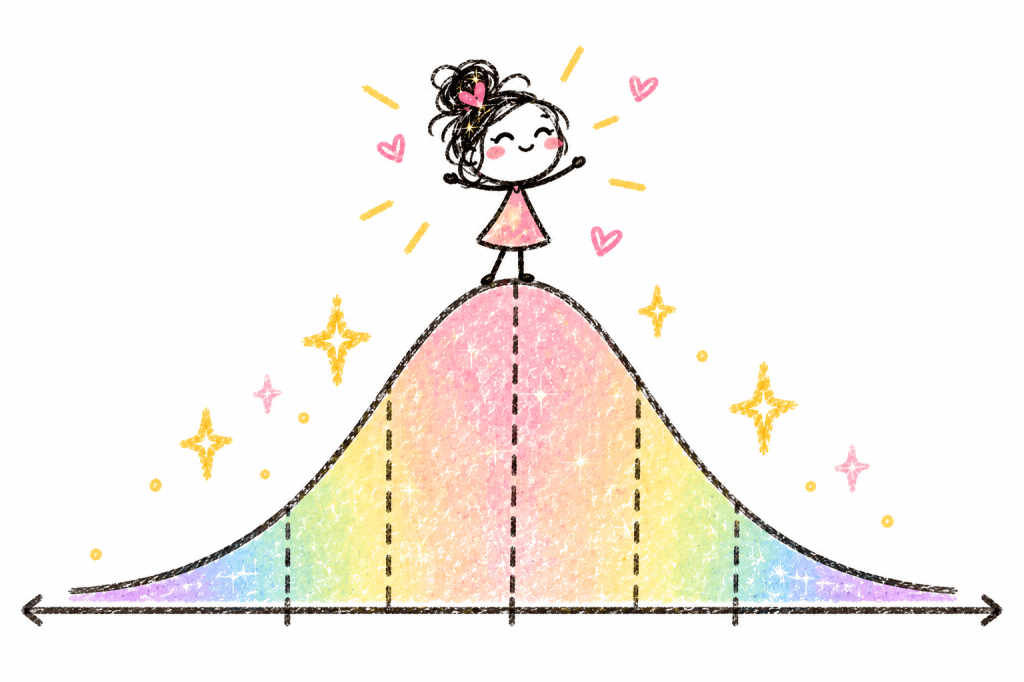
There are eight billion people in this world. We can’t all be outliers. Even if we’re exceptional at one thing, we’re probably perfectly average at countless others.
That’s how the bell curve works.
Most of us are mediocre at most things. And that’s perfectly fine.
You Don’t Have to Be Better
Accepting mediocrity doesn’t mean giving up. It means recognizing that I can try my best without needing my best to be exceptional.
I can pursue a hobby without becoming an expert. I can do my job well without being the highest performer. I can enjoy something I’m not particularly good at.
And if somebody gives me constructive criticism, I can learn from it if I want to. But if I don’t want to improve in that particular area, that’s fine, too.
Not every weakness needs fixing. Not every skill needs developing. Not every piece of feedback needs to become a personal growth project.
I don’t owe the world a better version of myself every single day.
I can decide what deserves my energy, and I don’t need to justify every decision to an imaginary panel of judges evaluating my potential.
That’s not a loser mindset. That’s autonomy.
There Is No Best Way to Live
We spend an absurd amount of time trying to find the best option. The best career, the best investment, the best city, the best way to spend our time.
We research, compare, and second-guess until making a decision becomes more exhausting than living with it.
But here’s the thing: you cannot optimize your entire life.
Every choice comes with trade-offs. Every path has its inconveniences. There will always be an alternative you haven’t considered, a decision you could have made differently, or a person who seems to be doing things better.
So what?
Sometimes, you just need to choose what you want, accept the trade-offs, and keep moving.
Not every decision needs to be the best decision. Sometimes, good enough really is good enough.
The Freedom of Being Ordinary
I still want to do things well. I want to learn, enjoy my hobbies, and build a life that feels meaningful to me.
But I want to do these things on my own terms.
I want to draw badly if I feel like drawing. I want to take an unflattering photograph and move on. I want to pursue something because I enjoy it, not because I need to prove I’m good at it.
I don’t need to be the best. I don’t even need to want to be the best.
I can accept criticism without automatically acting on it. I can acknowledge my limitations without turning them into lifelong improvement projects. I can try hard when something matters to me and stop when I’ve had enough.
You are not a startup. Your life does not need to demonstrate continuous improvement every quarter.
You’re a person. You’re allowed to have limits, make imperfect decisions, and remain mediocre at things you have absolutely no interest in mastering.
The bell curve exists for a reason. Not everyone can be an outlier, and frankly, not everyone needs to be one.
I’m still growing when I want to grow. I’m still trying when I want to try. I’m just no longer interested in making self-improvement a lifelong obligation.
I’m allowed to be mediocre. I’m allowed to be imperfect. I’m allowed to be nobody special.
So choose what you want. Try what interests you. Accept that some things won’t work out, and let other people have their opinions.
Stop looking for the absolute best way to live.
You have a life to live, not a performance to optimize.


Leave a Reply