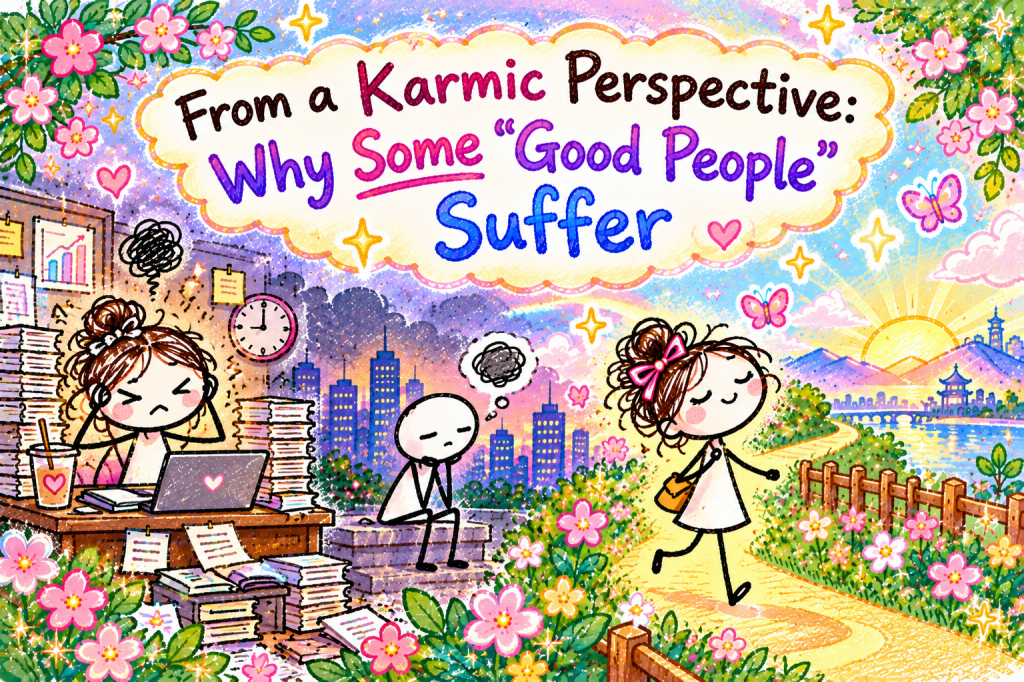
Why do some people seem to try their best, do what they believe is right, and still struggle endlessly?
They work hard, fulfill their responsibilities, and consider themselves good people. Yet their careers stagnate, their relationships suffer, and one setback follows another. They wonder why life is so unfair when they’ve sacrificed so much.
From a Buddhist perspective, karma doesn’t always ripen immediately. Today’s difficulties may stem from past actions, while the wholesome karma we create now has yet to bear fruit.
But there’s another explanation that fewer people recognize.
What do we actually mean by “good people”?
From an ordinary, worldly perspective, we tend to consider people good when they work hard, fulfill their obligations, avoid obvious wrongdoing, and don’t deliberately hurt anyone.
Yet being a “good person” on the surface doesn’t mean understanding karma or cultivating wholesome intentions.
I’ve observed two patterns that illustrate this.
1. The hardworking person who keeps struggling
Some people are ambitious, disciplined, and willing to sacrifice enormous amounts of time and energy to get ahead. Yet despite their relentless efforts, they struggle to achieve the results they want. Their careers stagnate, their businesses fail, and frustration becomes a way of life.
Look at how they treat people.
They rarely offer encouragement or compassion. They help when there’s something to gain. Their efforts are driven by ego, greed, status, or the need to prove themselves rather than genuine concern for others.
In Buddhism, cetanā means intention. Intention is central to karma: two people can perform the same action while cultivating entirely different mental states.
Working hard isn’t inherently virtuous. Neither is ambition.
If every effort is driven by the desire for wealth, recognition, or superiority, what exactly are you cultivating in your mind?
When exhaustion turns into resentment, these people take their frustration out on others. They expect people to understand their sacrifices, praise their achievements, and accommodate their moods. When they don’t receive the recognition they believe they deserve, they become bitter.
Their stress damages their relationships, creating even more dissatisfaction. They keep striving, resenting, and repeating the same cycle.
They’re so focused on what they want from life that they never examine what they’re putting into it.
This is avidyā, or ignorance: failing to understand the causes and conditions that perpetuate suffering. They may know how to build a business or climb a career ladder, yet remain blind to the intentions and behaviors they’re reinforcing.
They want different results without changing the causes they’re creating.
2. The person who doesn’t hurt anyone, but doesn’t try to understand anyone, either
Others appear calm and stoic. They don’t gossip, lash out, or create drama. They go to work, come home, fulfill their obligations, and mind their own business.
On the surface, they seem harmless.
But being quiet isn’t compassion. Avoiding deliberate harm isn’t the same as understanding how your actions affect others.
Some people are emotionally detached, not because they’ve cultivated wisdom, but because they simply don’t engage with other people’s feelings. They offer no comfort when someone needs it. They remain silent when empathy is called for. They hurt others through coldness, poor communication, and a lack of consideration, often without realizing it.
They may not be malicious. They simply don’t pay attention.
But not intending to hurt someone doesn’t erase the consequences of their actions.
Without understanding the Dharma, people can mistake the absence of obvious wrongdoing for spiritual development. They fulfill their obligations but rarely examine their minds, question their assumptions, or reflect on their behavior.
It’s like rowing a boat with perfect composure without ever checking the map. The boat moves, but the passenger has no idea where they’re going.
And their lives keep following the same pattern.
They repeatedly encounter unfortunate events in their careers, finances, and relationships. Things go wrong, yet they rarely ask why. They don’t reflect on cause and effect or investigate the patterns behind their difficulties. They simply accept each setback as bad luck.
They move through life like robots, repeating the same routines year after year, never questioning why things remain unchanged.
They cannot change what they refuse to examine.
They keep experiencing the same difficulties because they never recognize the causes that need to change.
The Counterexample: Why My Life Keeps Getting Better
I’m not particularly hardworking or ambitious, nor am I exceptionally calm or emotionally detached. I’ve made plenty of mistakes and had my share of unwholesome patterns.
Yet I’ve learned to suffer less by examining myself, acknowledging my mistakes, and making a conscious effort not to repeat them.
In Buddhism, repentance goes beyond feeling sorry for past mistakes. It involves recognizing wrongdoing, taking responsibility, correcting one’s course, and resolving not to repeat harmful actions.
This brings us to what is often known as the paradox of self-improvement.
The more some people understand themselves, the more flaws they notice. The more they examine their behavior, the more patterns they recognize. From the outside, they may appear overly emotional, troubled, or preoccupied with problems.
But seeing more problems doesn’t mean having more problems. It means recognizing problems that were already there. That awareness creates an opportunity for change.
By recognizing my patterns and taking responsibility for my actions, I can stop reinforcing destructive habits and create different causes for the future.
So, why do some “good people” suffer?
Because hard work, quietness, and outward composure tell us very little about a person’s understanding of themselves.
We can work hard without cultivating kindness. We can avoid conflict without cultivating compassion. We can fulfill every obligation while remaining blind to the patterns that perpetuate our suffering.
The Buddhist teaching of pratītyasamutpāda, or dependent origination, explains that suffering arises through causes and conditions. Our experiences are shaped by interconnected intentions, actions, habits, and circumstances.
Karma isn’t simply fate. It’s about understanding cause and effect and becoming more conscious of what we create.
We cannot rewrite every cause we’ve already set in motion. But we can stop blindly creating the same causes and expecting different results.
Don’t just ask whether you’re a good person.
Ask whether you understand the causes of your suffering, whether you recognize your own patterns, and whether you’re willing to change them.
The goal isn’t merely to look like a good person. It’s to understand your karma, create less suffering, and stop repeating the patterns that keep you trapped in it.


Leave a Reply