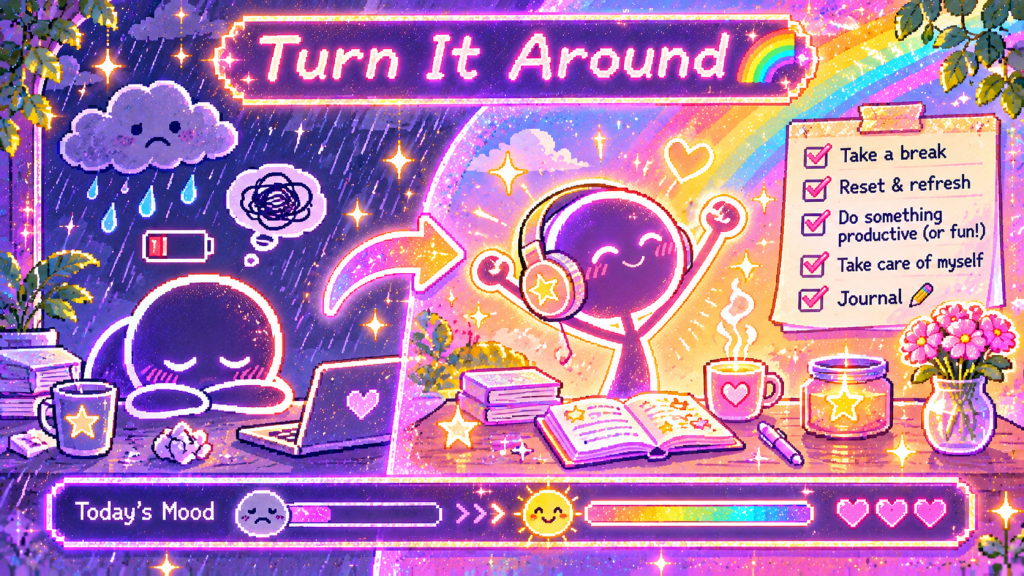
Have you ever had one of those days when something shitty happens first thing in the morning, and suddenly you just want to crawl back into bed and cancel the entire day?
Or perhaps your day started beautifully, everything was going well, and then one unpleasant incident happened around noon. Somehow, that one thing ruined your mood, one thing led to another, and before you knew it, you were carrying that negativity into everything else.
You stop enjoying yourself. You lose motivation. You become irritated over little things. And all you can think about is how much you want the day to be over.
I’ve been there.
But here’s something I’ve learned: a bad part of your day doesn’t have to determine the quality of the entire day.
If you have the energy and genuinely want to, you can still turn things around. Even at 3 PM. Even at 5 PM. Sometimes, even with just a few hours left before bedtime.
Here are some things I personally like to do when I want to rescue a day that’s going downhill.
1. Take a break and mentally start over
First, give yourself a proper break. Ideally, one to two hours, or at least one hour if you can manage it.
Make a conscious decision that whatever happened earlier has happened. It’s over. Consider it a rough draft that you’re no longer interested in keeping. Tear it up. Delete it. Whatever happened, happened.
You don’t have to keep mentally replaying the incident or carrying it into the next part of your day.
Use this time to create a little separation between the unpleasant experience and whatever comes next.
I personally like doing small things around my room. Make the bed, change the bedding, organize my makeup or skincare products, tidy up my desk, or do a little skincare routine.
Nothing particularly ambitious. Just enough to change my surroundings and shift my attention.
Think of it as creating a new starting point.
2. Set yourself up for success
Once you’ve had your break, think about what you want the next part of your day to look like.
If you have the energy, get some work done. Finish a task, run an errand, do some housework, or tackle something you’ve been putting off.
If you’re feeling tired, choose something lighter. Read a book, work on a hobby, enjoy an interest, or do something that makes you feel engaged.
And please don’t underestimate the power of small accomplishments.
You don’t have to complete an entire project to feel productive. Take your supplements. Drink a few glasses of water. Make yourself a cup of tea. Apply some hand cream or lip balm. Take care of a few little things you’ve been neglecting.
These activities require very little effort, but they give you a sense of agency. You’re doing something good for yourself. You’re taking care of your body. You’re making small decisions and following through with them.
Sometimes, that’s exactly the momentum you need to get out of a funk.
The goal isn’t to become extraordinarily productive in the remaining hours of your day. It’s to regain that feeling of being proactive and in control of your own time.
3. Stop trying to fix your mood through other people
This one is particularly important.
When you’re upset, exhausted, or emotionally overwhelmed, try not to immediately seek an external outlet by lashing out at someone, calling friends or family members to complain, or venting to whoever happens to be available.
Sometimes, the best thing you can do is retreat into your own little world for a while.
Go to your room. Be quiet. Stop engaging with unnecessary conversations. Give yourself some time away from other people’s opinions, reactions, and energy.
Turn inward instead of outward.
You don’t have to explain your mood to everyone. You don’t have to make other people participate in your emotional recovery. And you certainly don’t need to turn one unpleasant experience into several more unpleasant interactions.
Let yourself settle down first.
4. Do a little physical and environmental reset
Never underestimate the psychological effect of taking care of your immediate surroundings.
Take another shower, even if you’ve already showered in the morning. Wash away the day’s accumulated sweat, stress, and unpleasantness. Light a candle. Brush your hair. Brush your teeth. Change into comfortable clothes. Take the trash out.
I also like the idea of treating these little rituals as a symbolic cleansing.
From a feng shui perspective, getting rid of rubbish and clearing stagnant spaces can represent letting go of old energy. Whether or not you subscribe to that belief, there’s something undeniably refreshing about returning to a clean, pleasant environment.
Sometimes you don’t need to solve every problem in your head. You just need a clean room, a fresh set of clothes, and a shower.
A physical reset can make an emotional reset feel a little easier.
5. Don’t rush to end the day
This might sound a little counterintuitive, but if you’re still awake, reasonably energetic, and have the opportunity to enjoy yourself, don’t automatically give up on the day and go to bed at 5 or 6 PM just because things went badly.
Of course, if you’re genuinely exhausted, rest. There’s no need to force yourself to stay awake.
But sometimes, going to bed early just because you’re upset means you’re allowing an unpleasant experience to occupy the entire day.
Instead, give yourself a few more hours to enjoy something.
Make yourself a nice dinner. Watch a movie. Read a book. Play a game. Work on a hobby. Have a little snack. Do something that makes you happy.
I especially like this idea on weekends. If the morning and afternoon were disappointing, let the evening be something you actually look forward to. You can always sleep in the following morning.
Here’s another way to look at it: when you evaluate your day, you’re essentially looking at the overall experience, not just one isolated incident.
If the first half was unpleasant but the second half was genuinely enjoyable, the overall memory of that day can become much better.
You’re giving yourself new experiences to remember instead of allowing one bad incident to become the defining feature of the entire day.
6. Choose activities where you’re in control
This is another little trick I find particularly useful.
Some activities depend heavily on external circumstances and other people’s behavior. A meeting, an interview, a social gathering, or an important conversation can go well or terribly depending on factors you don’t entirely control.
But there are plenty of activities where you’re the one calling the shots.
Reading a book, watching a movie, organizing your room, doing diamond painting, playing a game, journaling, or enjoying a personal hobby.
You decide what to do, when to do it, and how much you want to enjoy it.
There’s something comforting about choosing an activity where the outcome is largely in your own hands.
If the earlier part of your day was dictated by circumstances beyond your control, make the remaining hours about things you can control.
Give yourself an opportunity to experience something pleasant without having to depend on anyone else to make it happen.
7. Journal your way out of a bad day
Finally, write about it.
Sometimes an unpleasant experience becomes even more exhausting because we keep replaying it in our heads without actually processing it.
Put those thoughts somewhere outside your mind.
Write about what happened, how you felt, what triggered your reaction, and what you might learn from the experience. You don’t have to come up with a profound life lesson every time something goes wrong. Sometimes you just need to get the feelings out and organize your thoughts.
And if you’re feeling particularly creative, turn the experience into a blog post.
That’s something I personally enjoy doing. An unpleasant experience can become an opportunity to reflect, write, create, and produce something tangible.
Suddenly, the incident isn’t just something that ruined your morning. It has also given you something to work with.
Even a shitty experience can become useful material.
And honestly, there’s something quite satisfying about that.
You Can Always Start Again
I think one of the biggest misconceptions we have about time is that we treat a day as one indivisible unit.
A day has 24 hours, and somehow we expect all 24 of them to share the same mood, energy, and overall quality.
But who decided that?
You can divide your day into two halves. You can divide it into four-hour blocks, three-hour blocks, or even smaller intervals. These are perfectly valid ways of experiencing and organizing your time.
If the morning was terrible, the afternoon can be better. If the afternoon was disappointing, the evening can still be wonderful.
You don’t need to wait until Monday, next month, or the beginning of a new year to start over.
People talk about turning their lives around, turning a month around, or turning a year around. But you can turn a day around, too.
In fact, you can turn things around in the very next hour, the next minute, or even the next moment.
Maybe you had a terrible morning. Maybe you made a mistake, lost your temper, said something you regret, or simply woke up feeling anxious and miserable for no particular reason.
Whatever it is, the next moment is still yours to work with.
No amount of time is too short to make a fresh start.
You don’t have to let one bad experience claim the rest of your day. You don’t have to carry yesterday’s mood into tomorrow, either.
Sometimes, all you need is a little pause, a small change of scenery, a few manageable tasks, and the willingness to give yourself another chance.
The day isn’t over just because a part of it went wrong.
You can still turn it around.


Leave a Reply