Businesses sign non-disclosure agreements all the time. Before negotiations, employment arrangements, business partnerships, or confidential discussions, people agree that certain information must remain private.
The principle is straightforward: not everything needs to be disclosed, and not everyone is entitled to know everything.
So why have I been so careless with my own information?
Why have I been giving away my deepest thoughts, private emotions, personal fears, ambitions, regrets, insecurities, and experiences to people around me, sometimes even complete strangers, for absolutely nothing?
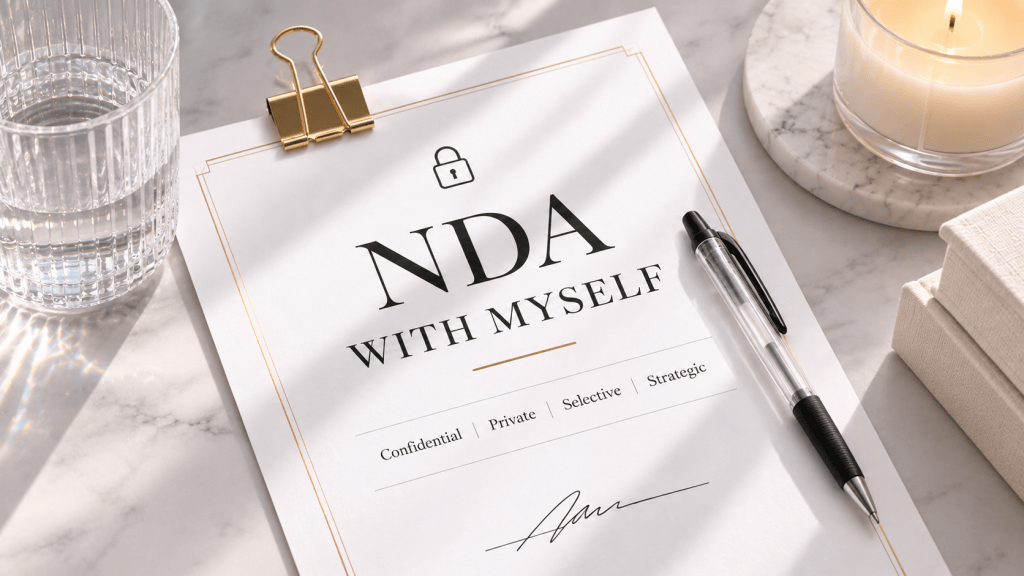
Perhaps it’s time I signed an NDA with myself.
Information Is Leverage
An NDA isn’t necessarily about distrusting someone. It’s about recognizing that once information leaves your possession, you lose control over how it is interpreted, retained, circulated, or used.
You cannot control what someone thinks after hearing your story. You cannot control whether they draw the wrong conclusions, share your information with someone else, or use what they know to their advantage.
Even without malicious intentions, people can misunderstand you. They can form opinions based on incomplete information, interpret your decisions through their own values, and permanently incorporate your vulnerabilities into their perception of you.
And sometimes, the information simply isn’t necessary.
Does someone really need to know what I’m thinking about them? What I’m planning? What I’m regretting? What I’m afraid of? Why I made a particular decision?
What exactly would that information accomplish?
Information has value. Privacy preserves that value. Disclosing everything indiscriminately is essentially giving away resources without knowing what you’ll receive in return.
I don’t need to make my entire inner world available for public inspection.
Stop Giving People Material to Work With
One of the biggest mistakes I’ve made is confusing honesty with total transparency.
I don’t want to lie to people, but I also don’t see why I should volunteer information that serves no purpose other than satisfying their curiosity.
The more someone knows about me, the more material they have to form opinions, make assumptions, anticipate my reactions, and influence how they approach me.
They might know what makes me insecure, what I’m hoping for, what I’m afraid of losing, what I want from them, or what kind of approval I’m seeking.
Why would I make all of that readily available?
In any interaction, information can influence the balance of power. The person who knows more about the other person’s motivations and vulnerabilities may have an advantage, particularly when disagreements or conflicts arise.
I don’t need to hand someone a map of my weaknesses and then hope they never use it.
Sometimes, the smartest defensive move is simply to disclose less.
Listen More. Reveal Less.
Here’s another advantage of keeping my mouth shut: it gives other people room to talk.
People reveal an extraordinary amount about themselves when they’re comfortable speaking. Their priorities, values, insecurities, ambitions, frustrations, expectations, and patterns of behavior often become apparent without anyone having to ask particularly personal questions.
I don’t need to interrogate anyone. I don’t need to make myself the center of every conversation. I can simply listen and pay attention.
What matters to this person? What do they react strongly to? What do they value? What makes them uncomfortable? How do they behave when they don’t get what they want? How do they treat people they perceive as having less power than themselves?
These observations are useful.
They help me understand who I’m dealing with, what kind of interaction I’m having, and how much access that person should have to me.
And unlike indiscriminate self-disclosure, listening doesn’t require me to surrender an equivalent amount of information.
I can learn without revealing. I can observe without participating. I can understand someone’s behavior without making myself equally exposed.
That is not manipulation. It is awareness.
Defense Is a Strategy
I used to think that being open and explaining myself was a way to prevent misunderstandings. But the reality is that people can misunderstand me whether I speak or remain silent.
I can disclose my intentions and still be judged. I can explain my reasoning and still be disagreed with. I can reveal my vulnerabilities and still be treated poorly.
There is no guaranteed reward for making myself more accessible.
So I’ve become more interested in controlling what I disclose than in controlling what other people think.
When someone behaves aggressively, condescendingly, or opportunistically, I want to understand the situation before reacting. I want to recognize what matters to that person, what they’re trying to achieve, and what kind of leverage they’re attempting to establish.
Sometimes the appropriate response is to challenge their assumptions. Sometimes it’s to refuse their demands, withdraw access, or simply walk away.
Not every attack deserves a counterattack. But I don’t want to be unnecessarily unprepared, either.
There is a difference between being passive and being strategic. Keeping my information private gives me more room to choose how I respond, rather than allowing someone else to dictate the terms of an interaction.
Defense is not weakness. Sometimes, defense is the strongest position from which to operate.
And when necessary, the ability to withhold information, withdraw cooperation, or deny someone access to what they want can be more effective than arguing with them.
Silence Is an Advantage
I also want to stop feeling compelled to participate in every conversation.
Someone says something inaccurate. I know enough to correct them.
Someone expresses an opinion I disagree with. I have plenty of arguments.
Someone makes a ridiculous assumption. I could spend twenty minutes explaining why they’re wrong.
But I don’t have to.
Not every incorrect statement requires my correction. Not every disagreement deserves my participation. Not every interesting conversation needs to become an opportunity for me to demonstrate what I know.
Sometimes, I can simply listen and move on.
Let people think I’m boring, uninteresting, reserved, or lacking personality. Let them underestimate how much I know or how much I’ve considered.
I don’t need to correct every impression they have of me. In fact, there are situations in which allowing someone to underestimate me is considerably more useful than trying to impress them.
I would rather retain my information than spend it trying to win a conversation that has no meaningful outcome.
An NDA with Myself
I don’t want to turn every human interaction into a business negotiation, nor do I intend to treat everyone as an adversary. I simply want to approach my own privacy with the same level of seriousness that organizations apply to confidential information.
My thoughts, experiences, plans, observations, and hard-earned conclusions have value. They are not public property, and they don’t become public property just because someone asks.
I don’t owe anyone a complete explanation of who I am. I don’t owe anyone unrestricted access to my vulnerabilities. And I certainly don’t need to disclose everything just to prove that I’m honest, friendly, intelligent, or interesting.
The world is complicated. People are complicated. Information travels, perceptions change, and circumstances can turn an ordinary interaction into a conflict of interests.
I would rather be discreet than exposed, observant than overly talkative, and prepared than unnecessarily vulnerable.
After all, not every card needs to be placed on the table.
An NDA isn’t just about keeping secrets. It’s about knowing the value of what you know, what you hold, and what you choose not to reveal.
And perhaps the most important agreement I can make is the one I make with myself.


Leave a Reply